ZT-100 Full-Cut Analyzer
Continuous water cut measurement from 0 to 100% — through phase inversion, through high salinity, without compromise
Where Conventional Instruments Stop. The ZT-100 Full-Cut Continues.
Every produced fluid stream eventually crosses the phase inversion boundary — the point where oil-continuous becomes water-continuous. Standard capacitance instruments reach this wall and stop. Saline produced water becomes electrically conductive, the dielectric signal collapses, and the measurement is lost precisely when it matters most.
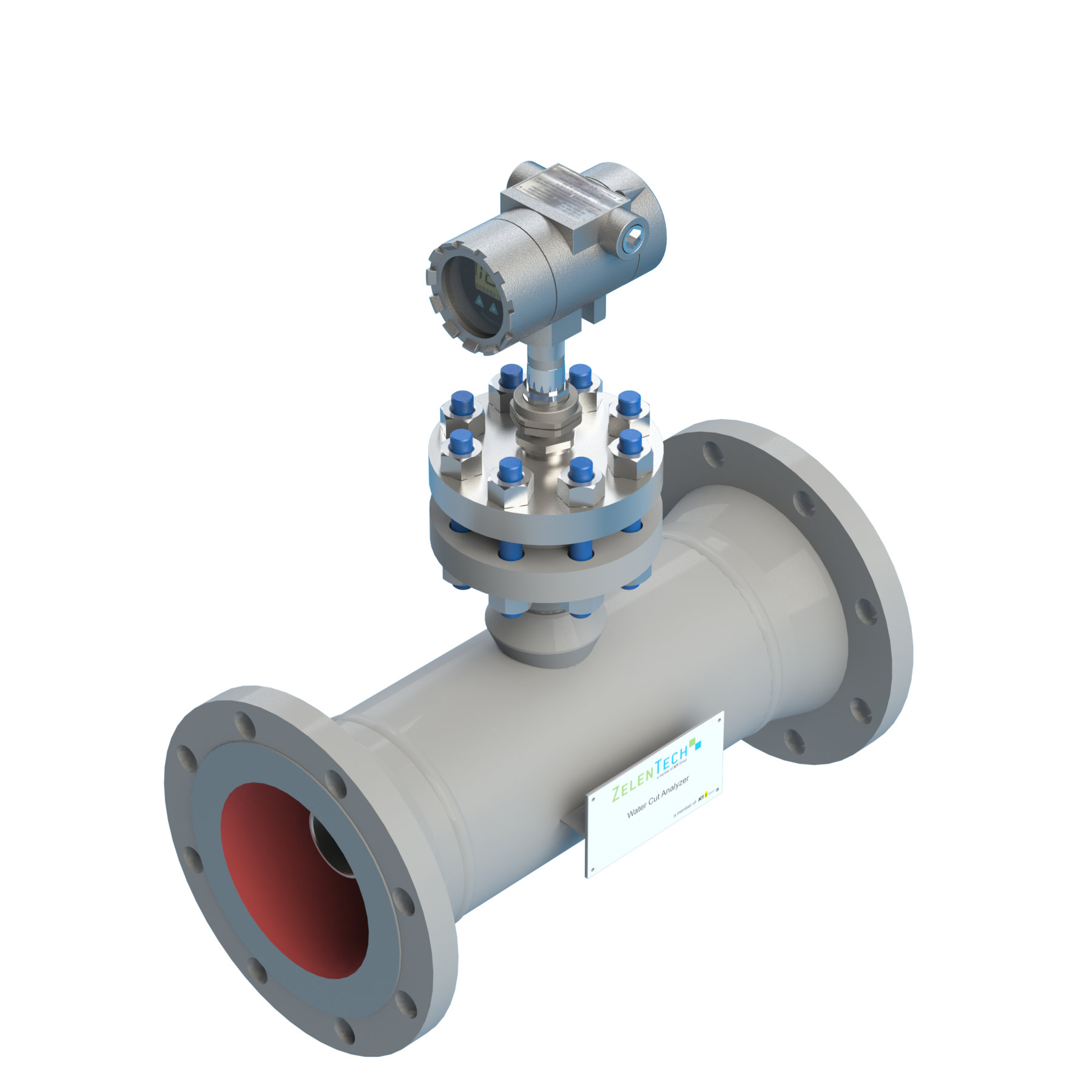
The ZT-100 Full-Cut Analyzer was engineered around this problem. Using a proprietary multi-frequency excitation architecture and an adaptive signal interpretation framework, it separates the dielectric component from the conductive component of the mixture response — extracting water cut information that conventional instruments cannot reach, across the full production range.
Measurement Architecture Built on Rigorous Physics
The ZT-100 Full-Cut operates on the principle that the complex permittivity of an oil-water mixture carries far more information than any single-frequency measurement can extract. Multi-frequency excitation unlocks this information across the full water cut spectrum.
ε″ = σ/ω + εd″
τ = ε0(ε₁+2ε₂) / σ₂
The differential response across the multi-frequency excitation window is processed through a neural network-assisted calibration model trained across the full operational envelope — water cut, salinity, temperature, and flow regime. The result is a measurement that does not degrade at phase inversion. It adapts to it.
Two Domains. One Continuous Signal.
The physics of oil-water mixtures are fundamentally different on either side of phase inversion. The ZT-100 Full-Cut resolves both — not by switching between sensors, but by resolving both simultaneously within a single sensor geometry.
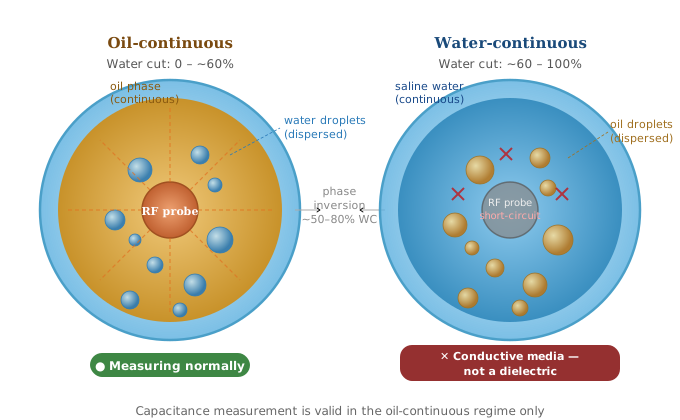
Dielectric Component Dominant
With oil as the continuous phase, the real part of the mixture permittivity tracks water fraction with high sensitivity. The contrast between oil (ε′ ≈ 2) and water (ε′ ≈ 80) provides a wide, well-conditioned measurement window. Multi-frequency excitation confirms regime identity and monitors approach to inversion continuously.
Conductive Component Resolved
Once water is continuous and saline, ionic conductivity dominates the low-frequency response. The multi-frequency architecture separates this from the frequency-dependent Maxwell-Wagner interfacial polarisation signature of the dispersed oil fraction. The differential response across the excitation spectrum remains a monotonic function of water cut — measurable, stable, and salinity-adaptive.
Engineered for the Full Lifecycle of the Well
Full 0–100% Range
Continuous measurement from dry oil through full water cut. No range switching, no dead bands, no phase inversion cliff.
Salinity Adaptive
Multi-frequency measurement architecture inherently compensates for varying produced water salinity without manual recalibration.
Neural Network Calibration
On-board inference model trained across the full operational envelope. Adapts to fluid property variation in real time.
ATEX / IECEx Certified
Certified for Zone 1 hazardous areas. Suitable for onshore and offshore installation in oil and gas production environments.
Standard Integration
4–20 mA analogue output, HART, and Modbus RTU over RS-485. Fits existing DCS and SCADA infrastructure without modification.
No Moving Parts
Solid-state insertion probe. No consumables, no optical windows to foul, no maintenance intervals beyond periodic calibration verification.
Technical Specifications
| Measurement Range | 0 – 100% water cut (WC) |
| Excitation Architecture | Multi-frequency; proprietary adaptive excitation |
| Phase Coverage | Oil-continuous and water-continuous, through phase inversion |
| Salinity Compensation | Adaptive — no manual salinity input required |
| Calibration Model | Neural network-assisted, effective medium theory basis (Bruggeman / Maxwell-Garnett) |
| Process Connection | Insertion probe; flanged or threaded; 1″ – 24″ pipe |
| Wetted Materials | SS316L standard; Hastelloy C-276 on request |
| Process Pressure | Up to 100 bar standard; higher on request |
| Process Temperature | −20 to +120 °C |
| Analogue Output | 4–20 mA (2-wire loop powered) |
| Digital Communication | HART 7 / Modbus RTU (RS-485) |
| Hazardous Area | ATEX / IECEx Zone 1, Ex d / Ex ia |
| Ingress Protection | IP66 / IP68 |
Where the Full-Cut Analyzer Delivers
Mature Field Production
High water cut wells where conventional instruments have reached their operating limit. Maintain measurement confidence through the life of field.
Three-Phase Separator Control
Continuous composition monitoring on oil and water outlets. Supports interface level control and water dump valve automation across the full WC range.
LACT and Allocation Metering
BS&W monitoring for custody transfer applications. Confident measurement even as produced water salinity and composition shift over reservoir life.
Well Testing
Rapid composition profiling during well tests without range pre-selection. Handles early low-WC wells and late high-WC wells with the same instrument.
Tank Dewatering Systems
Sump and boot monitoring for automatic dewatering control. Reliable cut detection regardless of water salinity.
FPSO and Offshore
Compact, robust, Ex-certified. Suitable for space-constrained offshore installations with standard process connections and DCS integration.
Measurement Confidence Across the Full Production Lifecycle
Contact Zelentech to discuss your application. Our engineers will recommend the right configuration for your fluid properties, process conditions, and installation requirements.